In a post on Immanence, Adrian Ivakhiv addressed one of the most important intersections or conflicts of modern metaphysical thought: in Deleuzian thought, and continental philosophy as a whole, the theory of connectivity and immanence that is brought forward in process-relational ontology. He discusses the divide between materialism (which uses phenomenology and material relations as a starting point for philosophical discussion) and idealism (which uses signification and perception as starting points for understanding.) This dichotomy establishes the stage for the development of most of Continental thought: Hume uses a materialist understanding to develop empiricism, Marx begins with a historical materialism, Heidegger ventures into an idealist discussion of metaphysics, Derrida uses idealist deconstruction methods, etc… The revolutionary events of May ’68 brought along a new line of thought, but also established the possibility for resolving tension between materialism and idealism. Deleuze and Guattari introduce the idea of immanence and machinic philosophy in Europe and all of a sudden theorists are reducing social, cultural, political and even personal functions into cogs and machines. Things like interconnectivity and resonance are stressed over hierarchal division and there is a prioritization of the deconstruction of the boundaries that divide endo- and exo-metaphysics. All of a sudden we are told not to question being but to follow trains of becoming. While this is incredibly revolutionary for the global community as a whole (outside of philosophical thought things like chaos mathematics are developed and emergence is defined as a scientific and not just philosophical idea), this reduction remains trapped within the same focus of the subject. All of these deconstructions begin with the subject and work their way outward, situating objects and systems to only be knowable to the subjects themselves and not as external beings. Knowledge, even in rhizomatic systems, is always situated to radiate outward from the root of the arborescent model: it is only possible to branch out from the subject in continental thought as it is today.
This brief (and by no means total) genealogy brings us to the question of starting places: where does philosophy begin, if not at the subject? Speculative realism provides an answer. For Levi Bryant this lies in a displacement of subject-thinking and critique as a whole. Bryant says, “Rather, this experiment would instead refuse the imperative to begin with the project of critique. In short, what if we were to ‘bracket’ the project of critique and questions of access, and proceed in our speculations as the beginning student of philosophy might begin?... … As first philosophers that refuse the project of critique and questions of access, we can begin by asking ourselves with what must we begin? What is the most fundamental and general claim we can make about the nature of beings?” (ST, 262-3). Bryant deems this most fundamental claim as the Ontic Principle: the most general claim is that all objects produce a difference. Bryant states, “It is not being claimed that all differences are important to us. Rather, the claim that there is no difference that does not make a difference is an ontological claim. The claim is that ‘to be’ is to make or produce a difference.” (ST, 264). It is with Bryant’s Ontic Principle that we find the potential for resolution between the conflict of Continental thought and Speculative Realism as well as idealism and materialism: between separation (object-oriented perspectives) and total connectivity (immanence).
This resolution comes through the metaphor of pointillism. As an artistic movement pointillism utilizes closely packed dots of a pencil or water color to produce the illusion of a larger macro-image: a higher density of these dots appears to be darker in shade, lower density looks to be lacking in presence. The mixing of these densities around a piece of art produce emergent shapes – faces, kids playing under umbrellas, trees, etc… While modern Continental thought conflicts with Speculative Realism over the notions of separation with object ontologies (that objects exist as independent, withdrawn ontologies), contending that in fact ontology is really defined by interactions and not by ontic properties that exist external to system-relations, the metaphor of pointillism provides an opportunity to challenge this entire contention. The assertion I make lies in the function of the plane of immanence itself on which objects produce relations. While there may be connections of immanence on impossibly small scales, the reductionist discussion that results from analyzing such an immanence only frustrates philosophical inquiry. Instead of approaching philosophy through a totalizing lens of immanence that refuses to view the object as entirely separate, we should use chaos mathematics to interpret the emergent patterns of zones of intensity on the body without organs, but also for zones of density on the relevant planes of immanence being discussed. Chaos mathematics becomes a progressive method for understanding systems that moves more toward an object-oriented ecology; a biomemetic/organic understanding of the Ontic that understands the relevance of both micro and macrostructures of objects and gives everything in between equal relevance in given contexts. This is all very abstract, so as I go I’ll provide examples. The first example comes from an object-oriented discussion of ecology (Tim Morton's area of expertise), that says there are no correct ways to view objects, but rather there are different scales that can differ in relevance. The example is a table: we can view the molecules that compose the wood, or the individual grains in a leg, or a table leg, or the table as a whole. None of these perspectives is more objectively correct than the other, but each produces a different context of relevance: the table leg can mean something to a carpenter while the table as a whole means another thing to a restaurant owner, and the grain of wood means something to a termite, and these objects to each other mean something entirely unknown. While the lens of immanence asks us to deconstruct the table as an object and view it as a constant stream of connected objects, this fuzzies the view of the table itself: it becomes incredibly difficult to see the table as a single object because we’re so busy determining what its micro-elements are becoming. Instead of dividing crudely between subject and object, or going in the opposite direction and deciding that there are no dividing lines whatsoever, we can understand the subject itself as an illusion, albeit a useful one, that is produced by the resonance of objects to produce an emergent intelligence. Objects form their own ecologies that have varying levels of relevance, different magnifications that we can view like the table. The plane of immanence becomes a function-platform, a playground, for the ecology of objects in and outside of metaphysics, as we understand it.
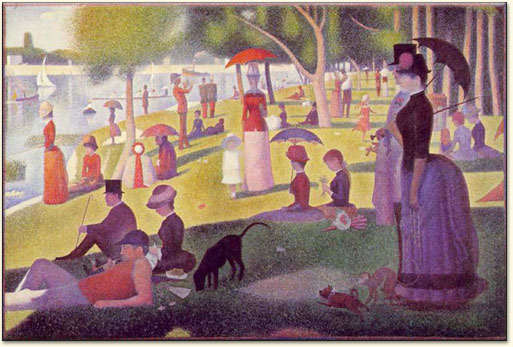
In pointillism there are no lines, only dots that have degrees of separation from each other: differences. However, these dots are sometimes placed so close together that lines become unnecessary. This is why the “truth” of whether subjects or objects exist in an elementary form is an unhelpful question, because it becomes so reductionist that there is no political translation. On this plane of immanence, like a pointillist work, there are affective/sensual zones of discernment in which we are given the optical illusion of form, but which is really an emergent network of objects relations. The subject is really just a coalescing of objects in a system/ecology that resonate together in a certain way; objects which are often withdrawn to the point that the “subject” cannot fully attune itself to their nature. From a scientific perspective it can often be said that these zones of density (and their surrounding areas) interact in a way that is intelligent: seemingly random interactions on a microlevel between the differences of two objects can produce system-relations on a macro level that respond in ways that are capable of progressive learning and adaptation to stimuli. These resonances can be anything from ant colonies that adapt to environmental changes to chemical and electrical signals in the brain to colonies of bacteria to entire ocean ecosystems that respond to invading species. It’s in this way that chaos math is a useful lens for analyzing the Ontic: these zones are relateable as pre-textual understandings (or in the case of relations object-qua-object they are simply withdrawn), feeling-perceiving that is a feeling-toward a given object or system. It is the intersection of mathematics and affective understanding. While this understanding begins with the subject, it musn’t always: zones of density are simply diagrammatic renderings of onticology. They are a rough map that is somewhat akin to the Marauders Map if it were taken inside the house on Ash Tree Lane – it is constantly shifting and amorphous but resembles a temporary rough outline of a given ontic ecology.
Here I will make a wandering aside to address an issue brought up by Bryant in “The Ontic Principle”, which I have referenced previously in this entry. Bryant confronts Hegel’s problem of “pure being” on page 265 of “Speculative Turn”, saying that Hegel inscribes negativity into being through his assertion that thinking pure being only results in thinking nothingness. This metaphor of pointillism resolves both the problem of Hegel’s pure being and the need to resort to deferral of questions of access to bypass it in metaphysics. Pure being is not just the presenced nothing, nothing that is thought, but is a specter that cannot be signified precisely because of its nature as a sensual/affective hyperobject. The subject-qua-subject cannot exist when it is thought because its nature is primal, spectral – it is a system of intensely withdrawn objects that are not placeable in words, but which represent the fabric of the subject. In shorter words, it is a system of objects that resonate at a given density to produce the illusion of the subject. These are feelings and perceptions that we experience as beings that we know define us, but cannot describe. Asking what pure being “is” is paradoxical because it would be like asking the illusory figure in a pointillist painting to jump off the canvas and view his own dots. It’s a problem of perspective. Pure being cannot be presenced as such; it emerges chaotically at the fringes of our vision (spectrally) under conditions in which it is not demanded to appear (as Deleuze and Guattari would say, it is not visited by the Judgment of God and cast into an organism). Pure being instead emerges on the plane of immanence (defined by its depth and density) as a body without organs constituted as an ontic population of objects that are not entirely intelligible. These objects are withdrawn, they remain a mystery that produce the wonder or curiousity that Baudrillard so adeptly describes as seduction. For object-oriented ontology it is termed as subduction – the object instead presences the subject, producing a desire in the subject-as-such to define its relation to the “self.” Re-described in this way Hegel’s “pure being” is really nothing but a set of ecologies – the product of the gravitational mystery of withdrawn objects caught in each others’ subduction fields to produce certain unique sensual properties. To presence it with inquiry is only to muddy the waters.
In the project of politics this theory provides some insight into Deleuzian theory. The concept of zones of differentiation among the macro-structure of the painting (here, the Political) makes questions of “lines of flight” less important than the way resonances ripple out across systems. To jump from one dot to another, one object-location to another, using a line is not what defines a revolutionary act but instead finding the best way to produce ripplings-out from given spaces becomes the best way to be political. Chaotic interactions of intelligent object systems and the way these ripplings-out can transform systemic relations between objects that are external to subject-ontologies (what I call exo-metaphysical objects) produce the macro-structures that we perceive to be the subjects on the painting. The “body” we perceive on the canvas is then only the result of a certain resonant pattern that emerges based on our micro-interactions with objects that are both internal and external to the subject. It becomes a question of process-relations rather than subject/object division because based on the context objects and subjects can be equally relevant – change the magnification and objects become far more political than any revolutionary. In politics, then, lines of flight become far less important than situating relations of objects in our surrounding area. Politics becomes first and foremost a question of space. The Egypt protests are a fantastic example: these protests were composed of resonances in public spaces using the physicality of the body, not as a subject, but as a sea of molecular objects that challenged the legitimacy of power structures insofar as power is only the product of a larger density that this counter-density, this Egyptian assemblage, challenges for territory. In both physical and intangible spaces this counter-density produces politics as a game of capture described by Deleuze and Guattari which is closer to representing a war between swarming ant colonies than to tanks moving on a battlefield. The game of politics becomes much more murky, most notably because there are exchanges in densities. Each cloud of objects clashes with the other and produces a confusion: Egyptians in the crowd become mixed in with riot police. This method of exchange makes the line of flight a less revolutionary tool than its resonant equivalent: lines just jump to different object locations and produce densities in different spaces in which they are potentially less helpful. Resonances in key spaces or nodes change input features of existing macroimages, producing a disruption of the overall image through a reclamation of space: it’s a deterritorialization of zones of density and a reterritorization that implies the production of a new shade of density that implies a new object-system. This object-oriented lens on political struggle requires us to look on every relevant level of magnification of the composition of the political table – both molar and molecular and everything in between. The micro of politics allows us to function in given spaces as political agents while the macro notion of the political is what we come to call History; the emergence of trends of statecraft and Foucauldian power structures over time becomes an incredible hyperobject unto itself, an active object producing difference. For Derrida this is Spectrality. This spectral object of the Historical produces difference and interacts with existing systems of objects through a liminal haunting that can’t be presenced as a body itself, but is yet another optical illusion produced by resonance that is neither present nor absent. In this way, the Political itself is only the product of a sea of objects, an ontic population, that have varying densities, depths and as Levi Bryant recently coined, brightnesses.


